
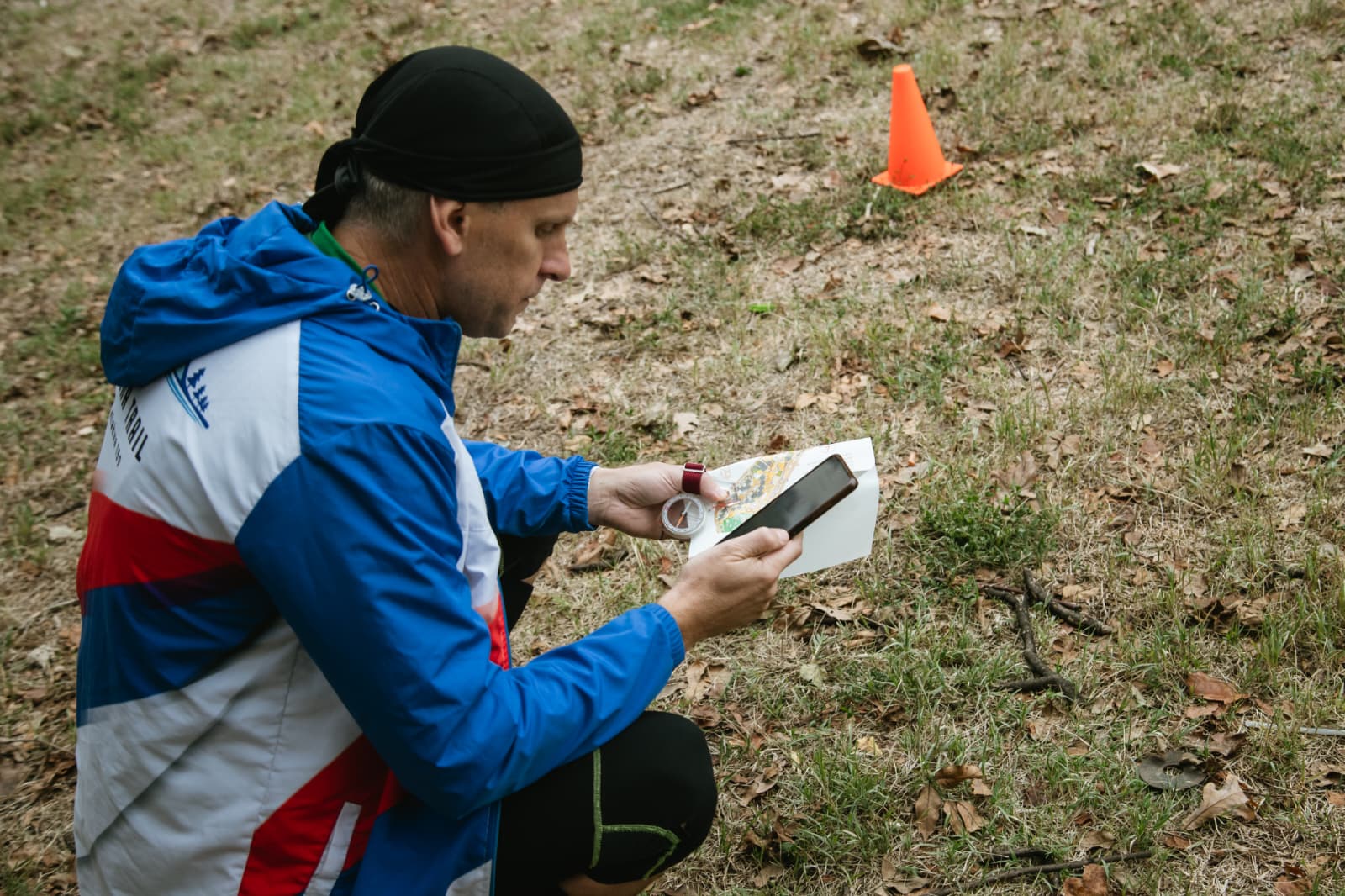
Within the European project O SIGN – “On: Sport in Nature, Good Nutrition and Young Hearts”, Mobile Orienteering (Mobile O) stood out as one of the most dynamic and innovative race formats, implemented across all five partner countries. This format reimagines traditional orienteering by placing teamwork, communication, and real-time decision-making at its core.
What is Mobile Orienteering?
Mobile O is a short orienteering race held in parks, similar in length to a sprint (around 15–20 minutes). The key difference? The runner does not use a map.
Instead, they receive live instructions via phone from a teammate who stays in the finish arena.
The teammate in the arena has access to the map and course and acts as the team’s “navigator,” guiding the runner step by step—giving directions, identifying landmarks, and helping make route choices. The runner must quickly understand and apply these instructions while moving at speed.
This role split turns the race into a powerful exercise in:
• clear and effective communication
• trust between teammates
• quick decision-making
• real-time adaptation
How it was implemented in O SIGN
Mobile O races were organized in all five partner countries, mainly in urban parks and accessible outdoor areas, as part of a broader set of four orienteering disciplines. The format was designed to welcome both beginners and experienced participants.
It also encouraged mixed teams, supporting interaction between people from different backgrounds and reinforcing the project’s focus on inclusion and European cooperation.
Key benefits of Mobile O:
- Strong teamwork and communication skills
Success depends on how clearly and efficiently the two teammates communicate under pressure. - Shared decision-making
The thinking is split: one person analyzes the map, the other executes in the field—similar to real-life team dynamics in many professions. - Easy entry for beginners
Participants who are not familiar with map reading can still take part actively as runners, making the sport more accessible. - Fast, engaging, spectator-friendly format
With short race times and visible action near the arena, Mobile O is easy to follow and exciting to watch. - Natural use of technology
The phone is not just an accessory—it is central to the race, connecting sport with everyday digital habits.
How the races were experienced in O SIGN
The start/finish arena was one of the most vibrant and memorable parts of Mobile Orienteering. It was filled with participants holding maps, gesturing, and speaking on the phone in different languages, all trying to guide their teammates out in the field—running without a map—towards the correct controls.
Expressions shifted constantly: confidence when things were going well, satisfaction when a route worked, confusion when the runner’s description didn’t match what was seen on the map, and moments of emotion and amusement when things became unexpectedly complicated.
Out in the park, the scene was just as dynamic. Runners moved through the course listening carefully to instructions through their headphones—some running confidently towards their next control, others suddenly stopping in the middle of a path, unsure of where to go next. In those moments, they described what they saw around them, waiting for their teammate to figure out where they had ended up and how to redirect them back on course.
This constant interaction between arena and terrain created a unique atmosphere—part strategy game, part communication challenge, and fully engaging for both participants and spectators.
Results and impact
Across the O SIGN project, Mobile Orienteering attracted hundreds of participants in competitions organized in all five partner countries. The format contributed to:
• increased interest in orienteering among the general public
• strong participation from young people and newcomers
• meaningful interaction between participants from different cultural backgrounds
Thanks to its interactive and collaborative nature, Mobile O quickly became one of the most appreciated race formats within O SIGN events.
Conclusion
Mobile Orienteering, as implemented in the O SIGN project, represents a modern step forward for orienteering. By combining physical activity in nature with real-time communication and teamwork, it creates a unique and engaging experience.
Its success across all five partner countries shows clear potential for future development—bringing orienteering closer to new audiences and making it more relevant, inclusive, and exciting in today’s world.
Funded by the European Union. Views and opinions expressed are however those of the author(s) only and do not necessarily reflect those of the European Union or EACEA. Neither the European Union nor the granting authority can be held responsible for them