
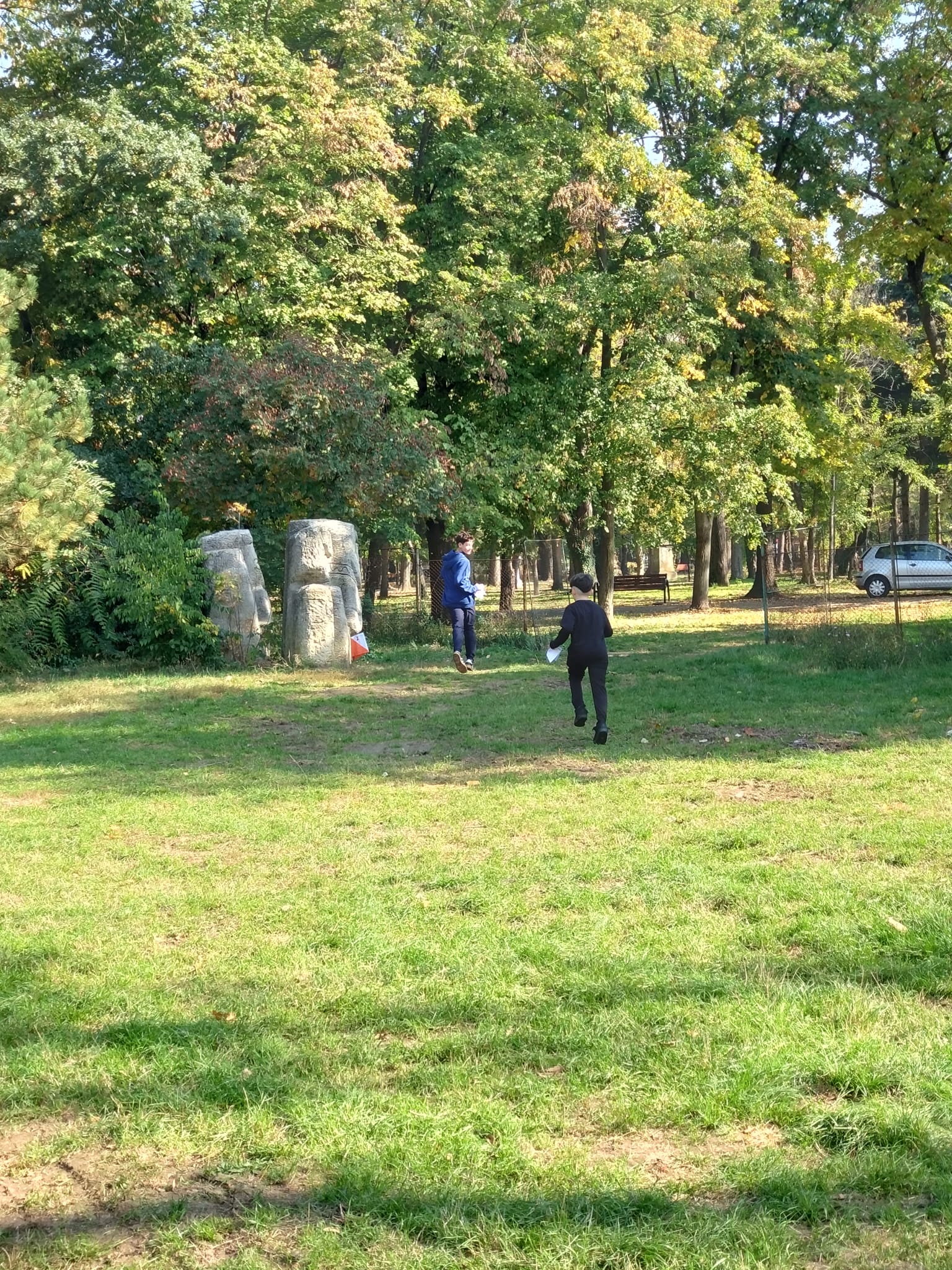
Within the European project O SIGN – “On: Sport in Nature, Good Nutrition and Young Hearts”, Sprint Orienteering brought intensity and dynamism, becoming one of the most attractive formats for the general public. Organized across all five partner countries, these races gathered numerous participants, especially beginners, young people, and adults over 55, proving that orienteering can be both accessible and exciting for all ages.
What is Sprint Orienteering?
Sprint Orienteering is a fast-paced discipline, usually held in parks or urban areas, where participants must find control points in the shortest possible time.
The races within O SIGN were timed using the SportIdent electronic system, the same used in Mobile Orienteering, ensuring precision and fairness in evaluating how fast each participant ran the race and if all controls of the course were taken in the right order.
Success in this format depends on:
• the ability to quickly read and understand the information provided by the orienteering map and course,
• rapid thinking,
• the ability to memorise, under physical effort, the route towards the next control point,
• choosing the most efficient route options,
• running at a sustained speed,
• making decisions under pressure.
Every second counts, and differences between participants can be minimal.
The key benefits of Sprint Orienteering are:
- Develops rapid thinking and decision-making
Participants must instantly choose the best route between controls, combining analysis with quick reactions. - Improves physical fitness
Running at speed, with frequent direction changes, enhances endurance and agility. - Strengthens concentration under pressure
Decisions must be made quickly, training focus and mental control. - Provides objective feedback and motivation
Accurate timing allows participants to compare performances and track personal progress. - Encourages learning and experience sharing
Post-race analysis and discussions turn competition into a valuable learning experience. - Builds social and intercultural connections
Interaction between participants from different countries fosters openness, communication, and a shared European spirit.
Results and impact
Sprint competitions organized across the five partner countries attracted numerous participants, including:
• beginners discovering orienteering in a dynamic format;
• young people drawn to the fast and competitive nature of the race;
• adults over 55, proving that performance is driven by motivation, not age.
Through this format, the O SIGN project successfully combined performance sport with accessibility and enjoyment.
How the sprint races were experienced in O SIGN
Sprint races were designed to be both accessible and challenging, attracting participants with little or no experience as well as more advanced runners. The atmosphere was energetic and competitive, yet friendly and fun. They involved exciting navigation, including portions of races through labyrinth ( see more at : https://www.youtube.com/watch?v=gyBcXUKFyI4)
After the races, the atmosphere naturally shifted from competition to conversation. Participants began comparing their split times and reflecting on the choices they made between controls, discussing where a few seconds could have been gained. Participants from different countries openly exchanged views on their routes and mistakes, with language differences proving no barrier—even for those with only basic English skills. Beyond the results, what remained was the true spirit of these events: rivals on the course, friends at the finish.
Conclusion
Sprint Orienteering, as implemented in the O SIGN project, shows that speed and strategy can go hand in hand with inclusion and community spirit. It challenges both body and mind, while offering the satisfaction of progress and the joy of competition.
Its success across all five partner countries highlights its strong potential to attract new participants and to position orienteering as a modern, energetic, and people-centered sport.
Funded by the European Union. Views and opinions expressed are however those of the author(s) only and do not necessarily reflect those of the European Union or EACEA. Neither the European Union nor the granting authority can be held responsible for them