
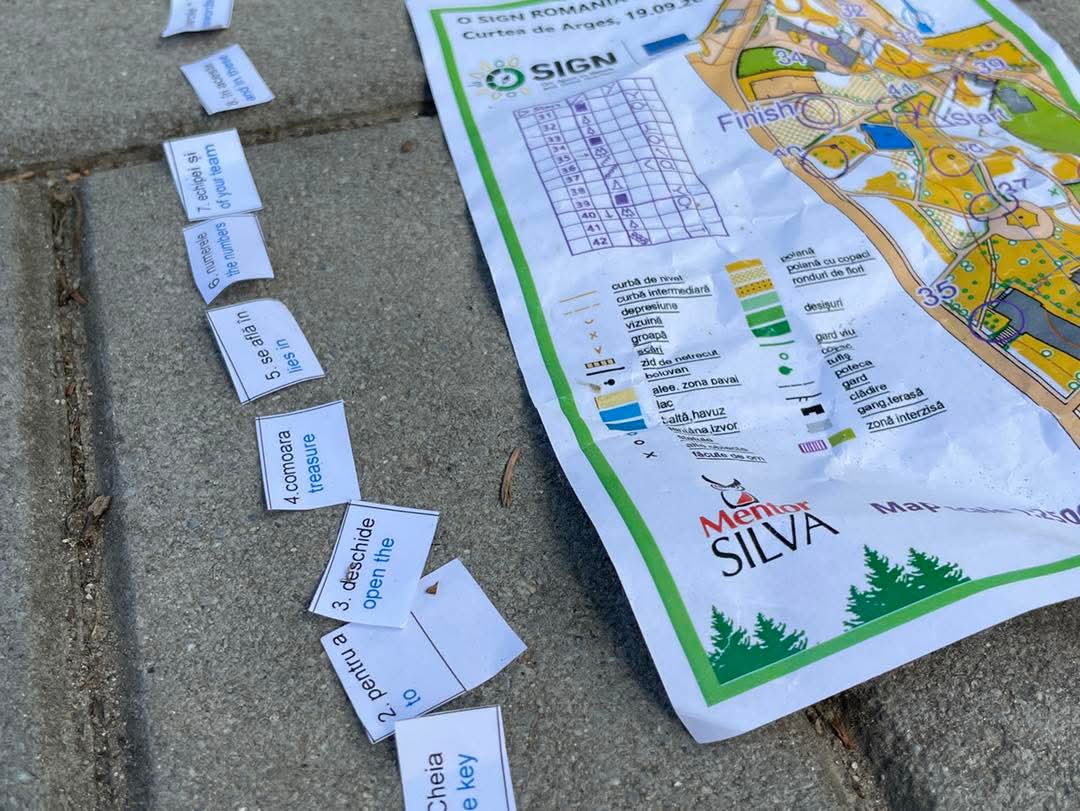
Within the European project O SIGN – “On: Sport in Nature, Good Nutrition and Young Hearts”, Treasure Hunting Orienteering brought a playful and exciting dimension to outdoor sport, especially for children and families. Implemented across all five partner countries, this format combines the fundamentals of orienteering with the thrill of a treasure hunt, turning every race into an adventure.
What is Treasure Hunting Orienteering?
Treasure Hunting is an orienteering-style activity where participants navigate between control points, most often in parks or safe outdoor environments. At each control point, participants—especially children—discover a clue.
When all clues are collected and put together, they lead to the final reward: unlocking the treasure chest at the finish.
The activity can be done individually, but it becomes even more engaging when completed in teams, where participants cooperate and often divide the control points between them to cover the course more efficiently.
How it was implemented in O SIGN
Treasure Hunting events within O SIGN were designed to be open, inclusive, and highly engaging, with a strong focus on attracting participants of all ages with young hearts. Courses were set up in accessible outdoor spaces, ensuring safety while maintaining a sense of exploration and challenge.
The format encouraged:
- team participation, including families and mixed-age groups;
- creative problem-solving, through clues that required attention and thinking;
- active movement, through running or walking between control points.
Key benefits of Treasure Hunting Orienteering
1. Promotes physical activity in a fun way
Children and participants stay active without feeling the pressure of a “competition,” as the focus is on discovery and play.
2. Stimulates curiosity and problem-solving
Each clue adds a layer of mystery, encouraging logical thinking, memory, and attention to detail.
3. Encourages teamwork and social interaction
When done in teams, participants communicate, plan, and cooperate—often splitting tasks and helping each other succeed.
4. Builds confidence and motivation
Reaching each control point and collecting clues creates a sense of achievement and keeps participants motivated until the end.
5. Accessible and engaging for all ages
The format is easy to understand and adaptable, making it attractive for young children, families, and even beginners with no prior experience.
Results and impact
Competitions organised across the five partner countries attracted numerous participants, including:
- children experiencing outdoor sport in an interactive and playful way;
- families participating together as teams;
- beginners discovering orienteering for the first time in a friendly format.
Treasure Hunting quickly became one of the most popular activities within O SIGN events due to its energy, creativity, and inclusive nature.
Conclusion
Treasure Hunting Orienteering, as implemented in the O SIGN project, proves that sport can be both active and playful. By combining movement, teamwork, and problem-solving, it creates a memorable experience that supports both physical and mental development.
Its success across all five partner countries highlights its strong potential to attract new participants, especially children, and to make outdoor sport more engaging, social, and fun for everyone.
Funded by the European Union. Views and opinions expressed are however those of the author(s) only and do not necessarily reflect those of the European Union or EACEA. Neither the European Union nor the granting authority can be held responsible for them